The Meiji Jingū (明治神宮) is the central shrine to Emperor Meiji and his wife, Empress Shōken. The site contains the main sanctuary, a park, a forest, a garden, a museum and more!
| 🎫 Tickets | ¥ 0,- |
| 🕐 Opening hours | Daily from sunrise to sunset (Per month times can be found here.) Buildings might only be open from 09:00 to 16:00 |
| ⏱️ Time needed | 1-2 hours (for the shrine and a walk around the grounds. Allocate more time if you want to visit the garden and/or museum too.) |
| ⛩️ About the sanctuary | Denomination: Shinto Enshrined kami: Emperor Meiji, Empress Shōken Festivals: several |
Meiji Jingū (明治神宮)
1-1 Yoyogikamizonocho
Shibuya City
Tokyo 151-8557

On this page…
For many people, Meiji-Jingū is a relief after days of Tokyo hustle and bustle. For me… It was the first thing I saw.
We had booked our hotel in a street full of typical Shinjuku bars and eateries, but on that very first morning we walked through a calmer part of town, had a local breakfast and ended up swallowed by the gravel path through the forest. I distinctly remember my awe when we encountered the first torii, looming at the entrance of it all. It was a truly amazing experience, and I can only recommend everybody to wake up early, so you have this magical place (almost) all to yourself.
Similar sights
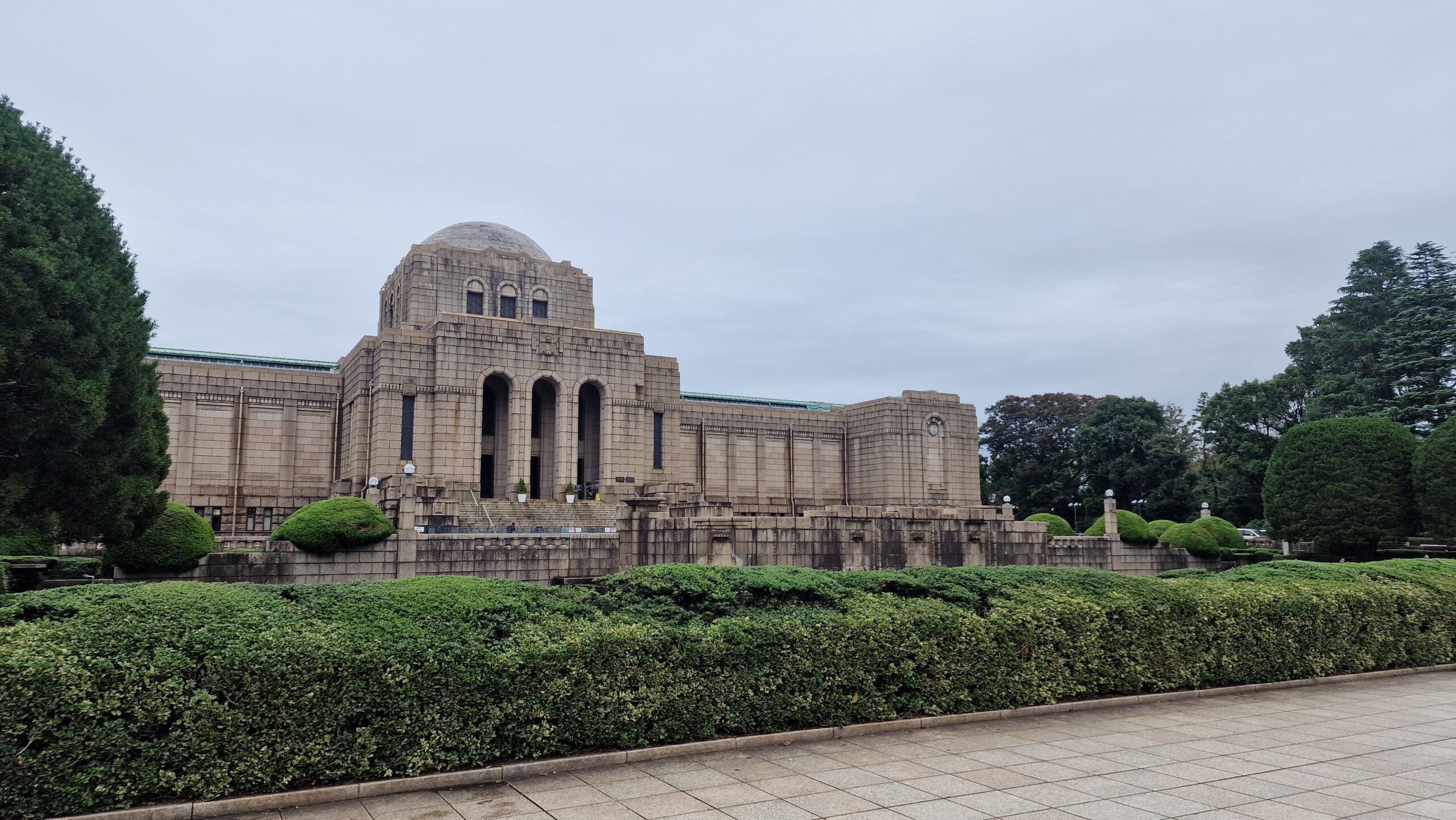
Five must-sees at the Meiji Shrine
Meiji Jingū is one of the most well-known Shinto shrines in Japan. It was built in 1920, eight years after the death of Emperor Meiji and six years after the passing of Empress Shōken. As the shrine has much to offer, we list the highlights for first-time visitors. For a more detailed overview, you can visit the map page of the shrine!
The Honden (Main Shrine) and Meoto Kusu
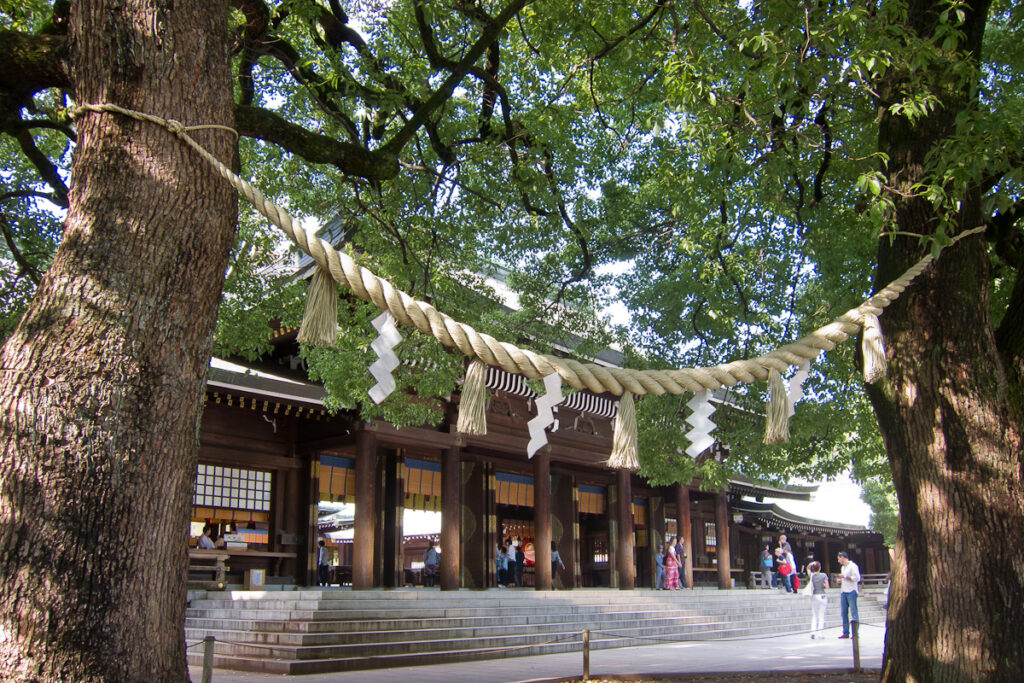
This is the core of the shrine and it is where the kami of the Emperor and the Empress are enshrined. Throughout the day, many rituals are carried out here. Daily, at 8:00 and 14:00, the ritual of onikkusai takes place. During this ceremony priests offer the kami sacred food and prayers.
In front of the shrine you can find the Meoto Kusu, a couple of camphor trees known as the Husband and Wife Camphor Trees. They are joined by a shimenawa, symbolising their sacred connection.
Sake Barrels
At the end of the Sandō, at the south approach to the main hall, a collection of sake and European wine barrels is displayed. These are annual offerings to the shrine from all over Japan and Burgundy, France. The fact that these are both Japanese and Western barrels is no coincidence as the Meiji restoration coincided with the reopening of Japan to the world and to trade – both economical and cultural – with the West. And while the actual barrels on display are usually empty, they represent the omiki (sacred sake) offered daily to the kami of the Emperor and Empress.
It is good to note that the addition of the casks of Burgundy wine is a more recent tradition. It started in 2006 as an ititiative of Yashuhiko Sata, representative of the House of Burgundy in Tokyo.
The Forest
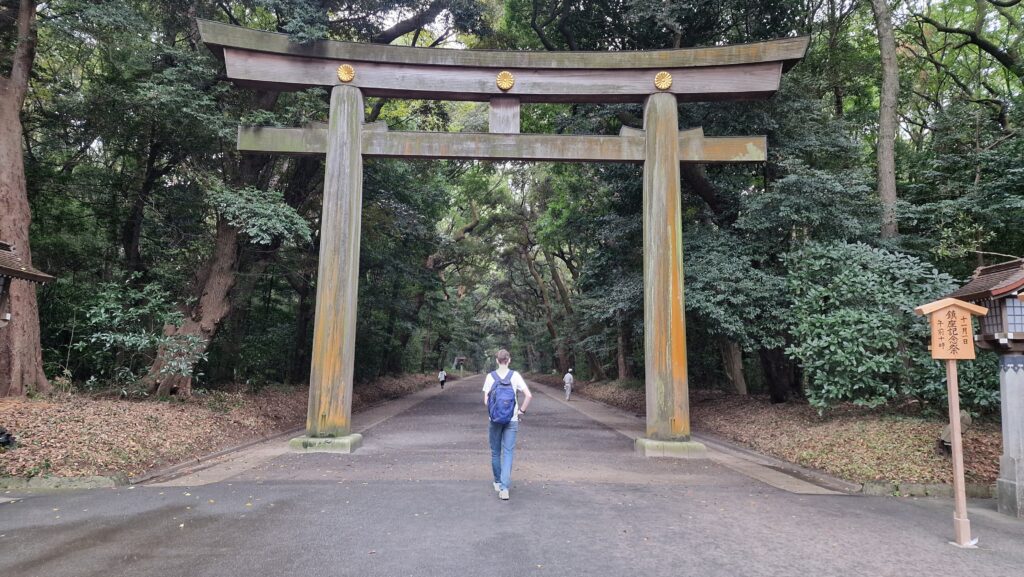
When the shrine was built, the surrounding barren lands got turned into a forest of 70 hectares/170 acres. Trees both young and old and from all sorts of varieties were moved from all over Japan to the shrine’s grounds. This gives the forest a very natural and ancient feel. It is a manmade self-regenerating natural forest, planned by forestry experts foreseeing 100 years ahead.
The Inner Garden
This garden maintains the irises of which the Emperor was so fond. The water from Kiyomasa no Ido (Kiyomasa’s Well) streams via the irises into the South Pond. No matter the season, it is always 15 degrees Celsius and it flows at a steady rate of 60 liters per minute. The water source is said to date back to a feudal lord of the late Azuchi-Momoyama period and the early Edo period. Kato Kiyomasa wanted to dig a basement and struck the well in the process.
- The irises bloom mid June. During that period, the garden gets particularly more visitors.
- The garden also offers beautiful azalea flowers in spring and vibrant maple leaves in autumn.
- Since the 2010s, the well is known as a ‘power spot’. Celebrities declared it lucky to have a picture of the well as your phone’s background.
The garden is open from 09:00 to 16:30 (16:00 from November to February). When the irises bloom, the garden extends the opening hours.
The admission fee is ¥ 500,- .
The (on site) Museum
This relatively new museum opened in 2019, just in time for the shrines centennial, in 2020. It displays some of the personal belongings of the Emperor and Empress, as well as the carriage used by Emperor Meiji on his way to formally declare the constitution of 1889.
The museum is open from 10:00 to 16:30. It closes on Thursdays and between exhibitions.
The admission fee is ¥ 1000,- .
Also Visit the Memorial Picture Gallery!
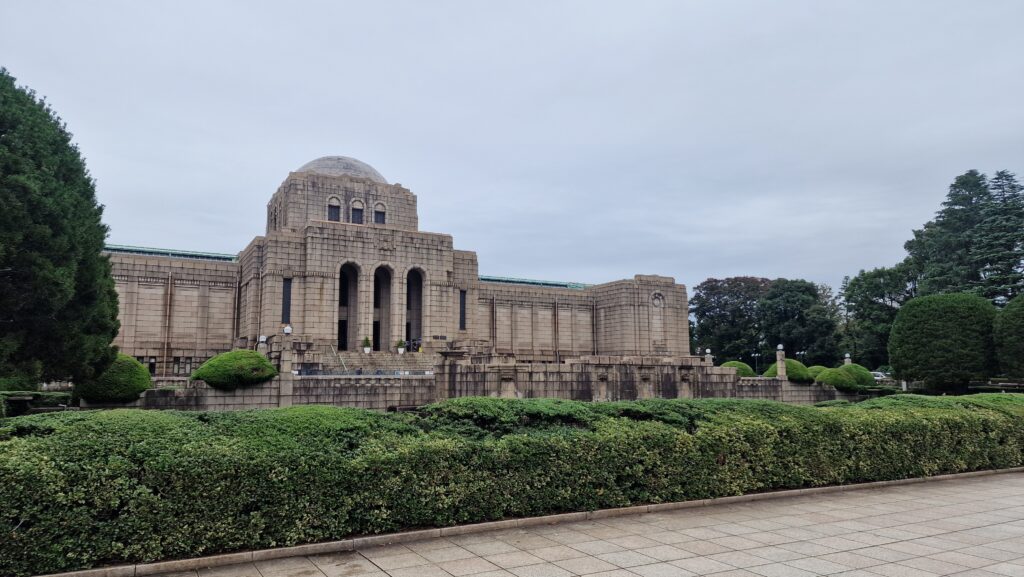
The Meiji Jingū shrine grounds cover a large area, consisting of the Naien (inner precinct) and the Gaien (outer precinct). The previous must-visit locations are all situated in the Naien. Looking for something to do in the surrounding Gaien? The Meiji Memorial Picture Gallery (or ‘Seitoku Kinen Kaigakan‘) builds your understanding of the Meiji Era!
No time to spare? Miniatures of the 80 pictures can also be found in the galleries surrounding the square in front of the Honden (main shrine).
History of the Meiji Jingū
Meiji Jingū was built on the site of an iris garden and was formally dedicated in 1920. Works started in 1915. It was formerly dedicated on 3 November 1920, with the inner grounds following in 1926.
The Enshrinement of Emperor Meiji (1920)
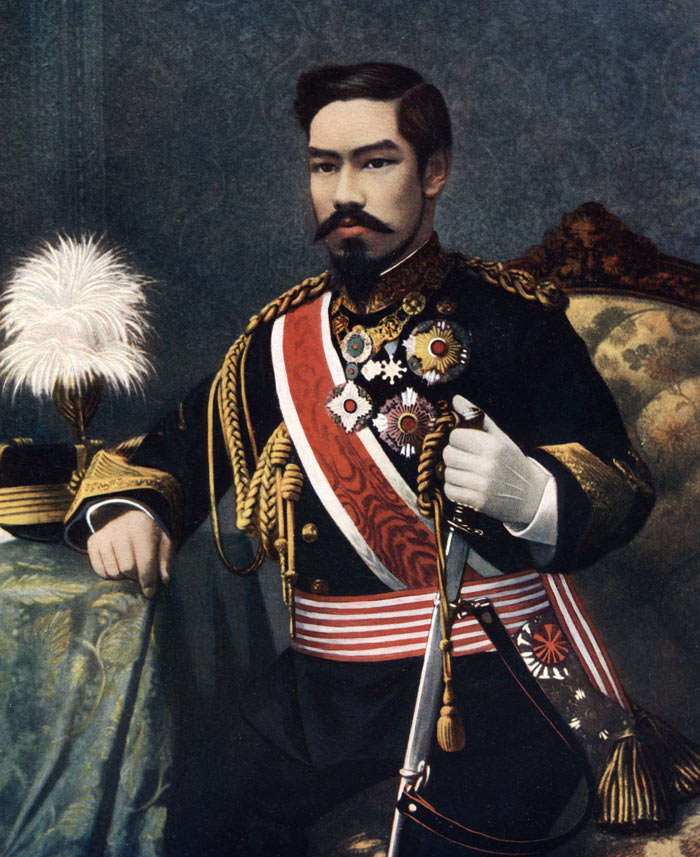
Emperor Meiji was born in Heian-kyō (modern day Kyoto) as prince Mutsuhito, in 1852.
He would become the 122nd emperor of Japan. His reign is marked by the end of the Tokugawa Shogunate, the start of the Meiji Restoration and the Meiji era.
The emperor reigned from 1867 until his death in Tokyo, in 1912.
Not long after Emperor Meiji’s death, the Japanese Diet chose the site of an Iris garden the Emperor loved as the location for Meiji Jingū. Although not the burial place of the Emperor, this shrine is the focal point in the celebration of Mutsuhito’s role in the Meiji Restoration. (The actual grave is located in Fushimi-momoyama, Kyoto.)
Emperor Meiji and Empress Shōken are commemorated together with their divine virtues: Waka poetry, the Charter Oath in Five Articles (the Meiji Restoration guidelines for building Japan) and the Imperial Rescript on Education (that led to Japan having the highest literacy rate among the ‘modern’ nations, but also promoted a moral order).
Destruction of the shrine (1945)
The shrine complex burnt down after the many air raids at the end of the Second World War. Luckily, the surrounding forest survived the bombings. Through donations after the war, the shrine got revived. It reopened in 1958.
Festivals at the shrine
Besides many daily, bi-weekly and on-demand rites, there are also a lot of annual events held at the shrine. They can all be found on the rites page of the shrine. We list a few important or shrine-specific ones below…
- 01/01 Saitan-sai is a New Year’s ceremony held at the Imperial Court and shrines throughout the country.
- 11/02 Kigen-sai is National Foundation Day. It commemorates the enthronement of Emperor Jimmu, the first emperor of Japan.
- 23/02 Tencho-sai is the celebration of the reigning emperor’s birthday
- 11/04 Shokenkotaigo-sai is the commemoration of the passing of the Empress
- 02/05 and 03/05 Sukeishatai-sai or Spring Grand Festival
- 30/07 Meijitenno-sai is the commemoration of the passing of the Emperor
- 01/11 Ritual Ceremony for Meiji Jingu Enshrinement Anniversary
- 02/11 and 03/11 Autumn Grand Festival celebrates Emperor Meiji’s birthday
Also on the shrine’s grounds
The grounds consist of the Naien (inner grounds) and later added Gaien (outer grounds). The Naien contains the shrine itself and the surrounding forest. The Gaien contains the picture gallery, the Kinekan and a variety of leisure facilities, such as the national sports stadiums.
Naien (inner precinct)
- Shrine buildings
- Museum
- Forest
- Garden
- MIRI
- Shiseikan Budojo
Gaien (outer precinct)
- Meiji Memorial Picture Gallery (聖徳記念絵画館)
- Meiji Kinenkan
- Jingū Stadium
- Jingū Secondary Stadium
- Japan Olympic Museum
Accessibility
You can find a map of the Naien on the official website.