🗼 Tokyo Tower (東京タワー, also: Japan Radio Tower) was built in 1958 as antenna tower and viewing point. Its architecture is inspired by the Eiffel Tower. Due to the many tall buildings surrounding the tower, a new broadcasting tower was built in 2012, the Tokyo Skytree.
| 🎫 Tickets | ¥ 3.500,- (Top Deck Tour) |
| 🕐 Opening hours | 09:00 – 22:45 |
| ⏱️ Time needed | 2 – 3 hours |
| 🗼 Packages | There are three main packages: – Main Deck (150m) – Top Deck Tour (150m + 250m) – Tokyo Diamond Tour (also includes lounge) |
Tokyo Tower (東京タワー)
4-2-8 Shiba-Koen
Minato-ku
Tokyo, 105-0011
〒105-0011 東京都港区芝公園4-2-8
Discover the light-up schedule!
Allocate extra time if you want to visit the shops and restaurants at Foot Town.
On this page…
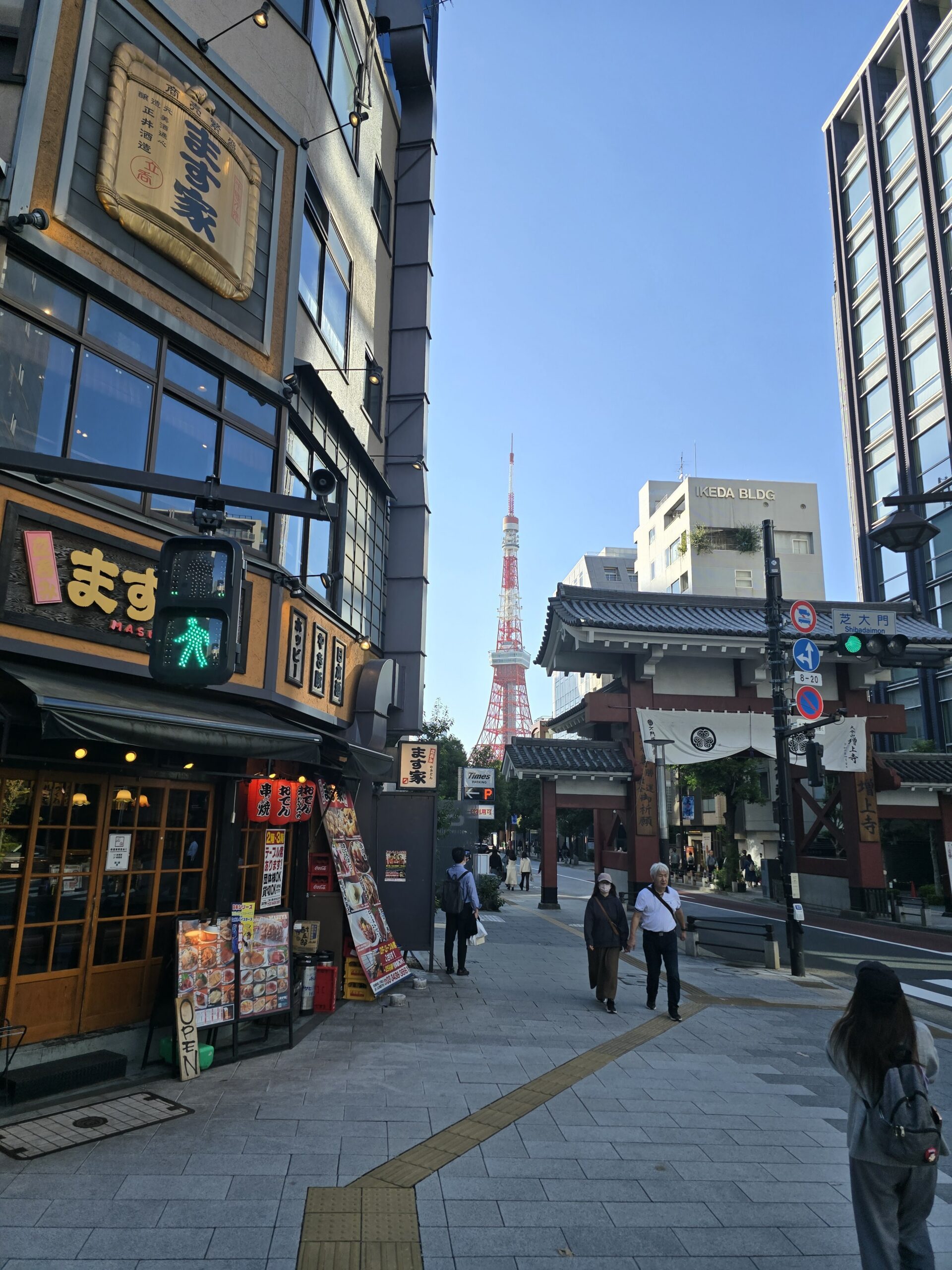
It was on the last leg of our first Japan trip… We had booked a room in the once great Prince Hotel next to Zojo-ji. At the bottom of our window older parts of shrines still stood amongst the plants. But they went almost unnoticed next to what we called our little nightlight: the grand dame that is Tokyo Tower, painted in red and all lit up…
A few days later, at the very foot of the tower, we said our goodbyes to the friend we were travelling with. He was backpacking Asia and would continue his journey. We would be getting dinner and had a plane back home in the morning. And at that very moment, I was awash with the romance of it all.
Similar sights

The History of Tokyo Tower
Tokyo Tower (333 meters) stands tall as a symbol of the rebirth, the hope and the exponential growth of post-war Japan. The tower was conceived in the late 1950s as a massive centralized antenna to transmit television and radio signals across the Kanto region. Its towering presence rapidly became an icon of the nation’s economic rise. While the tower was eventually functionally overshadowed by the newer, taller Tokyo Skytree (634 meters), which opened in 2012 and took over primary broadcasting duties, Tokyo Tower has cemented its place as a powerful piece of Shōwa-era nostalgia and a beloved cultural landmark.
Visitor numbers have naturally dwindled in the past decades. Yet, Tokyo Tower still attracts two to three million visitors every year. Guests are welcomed at the base of the tower in Foot Town. Foot Town is a multi-level shopping gallery and food court. It also housed the popular One Piece theme park from 2015 to 2020. From the top of Foot Town, tourists can choose: Visitors can take the elevator to the lower deck (Main Deck). Or, they can walk the 600 stairs leading to that level. From there you can go to the higher deck (Top Deck) via a collection of elevators.
The surrounding Shiba park connects the tower with the Minato municipality offices and the Zōjō-ji temple complex. The latter is famous for its connection to the Tokugawa shogunate.
Antennas
The tower was built mainly to host television antennae, but is also fitted with radio equipment. Tokyo Tower now primarily serves as a broadcast tower for FM radio (such as TokyoFM and InterFM) and continues to house key communications, quake-detection, and traffic monitoring devices. While it no longer handles digital television broadcasting – that role having moved to the Skytree in 2012 – it retains a vital function as a backup transmitter for major networks.
Former transmissions include several NHK stations, Nippon Television Tokyo, Tokyo Broadcasting System Television, Fuji Television Tokyo, TV Asahi Tokyo, …
Age of Economic Wonder
In the Fifties, television was booming! But all these new broadcasting companies needed a high point to transmit their programming from. To prevent the rise of multiple smaller broadcasting towers all around the city, the Japan government constructed one big tower to cover the whole of the Kanto region. This tower would originally be built at Ueno Park but due to its shallow bedrock depth and the height above sea level, city planners ultimately chose the current location, next to Shiba Park.
The tower was designed by Tachū Naitō, nicknamed ‘Doctor Tower’, who also designed many other television towers. Among his creations are the Tsutenkaku in Shinsekai, Osaka; Nagoya TV Tower; Beppu Tower and Sapporo TV Tower. They all have one particularity in common: they are strongly influenced by the Eiffel Tower in Paris.
Only the Tokyo Tower, however, stands taller than its inspiration: At time of completion it was the tallest free standing tower in the world at 333 meters. It beat the Eiffel Tower by a narrow margin of only 9 more meters. In the original plans the tower was even to be 381 meters high, the highest structure, but it got scaled down considerably due to concerns over excessive swaying, a lack of funding and a lack of materials.
The tower got its name from a contest. The most popular name was Shōwa Tower, after the reign of emperor Hirohito. Other popular names were Peace Tower and Rocket Tower. Even though Tokyo Tower ranked only 13th, judges chose it as the final name. The building remained strongly connected to Shōwa and Shōwa nostalgia as it was built at the height of ‘the Economic Wonder’.
Construction
The tower was built under the stress of sharp deadlines. (Construction only lasted 18 months.) To this end 400 tobi, Japanese construction workers, worked on the tower each day. A shift lasted 12 hours, from 06:00 to 18:00. In total 219,335 people worked on the build in one way or another.
To not be hindered or slowed down, the tobi did not wear any harnesses. There were no nets installed to secure the workers, either.
Tokyo Tower through the years
One of the most recognisable facets of the architecture of the tower, are the iconic red (‘international orange’) and white stripes covering the outer surface. Sometimes, the reason given behind the iconic red colour of the tower is the fact that the Eiffel Tower too used to be red. The Parisian tower had a venetian red colour between 1887 and 1889 and during early repaints, as well as a red-brown colour during the Fifties and Sixties. However: the reason behind the colour scheme in Tokyo are the local aviation laws. Due to the height of the tower, it is qualified as a air traffic obstacle, thus requiring the clear markings. The tower gets a fresh coat of red paint every five years. That job takes about one year to complete…
Tokyo Tower remained Japan’s highest tower until the construction of its successor, the Skytree, surpassed that point in 2010. They built this new tower due to the amount of new high-rise buildings surrounding Tokyo tower. These cause interference, and lower the reach of Tokyo Tower’s signals.
To capitalise on its height, Tokyo Tower has two viewing decks. The lower deck sits at approximately 150 meters high. Tourists reach it by either elevator or a 600-step staircase. The top deck sits at approximately 250 meters, right underneath the television broadcasting equipment.
Some further facts
- About a third of the 4,000 tons of steel used in the building of the tower, came from decommissioned American tanks, scrapped after the Korean War.
- The iconic warm glow the tower has on winter nights comes from sodium vapor lamps. For summer they use a cooler lighting scheme.
- The tower is one of Japan’s Registered Tangible Cultural Properties.