When talking about Japanese food, it is almost impossible to ignore sushi. When talking to friends and family about traveling in Japan, more usual than not, a question on the topic is included in that conversation. In this bite-sized article we will answer some of them! By the end of this article you will know where to look for your sushi fix, you will be able to tell the different kinds of sushi, and why it matters in what order you eat them! To wind down, we will also dive into the history of the dish ever so briefly!
In this article…
Something for everyone…
🍣 What are the main types of sushi? 🥢
Popular kinds of sushi you might encounter on your travels are:
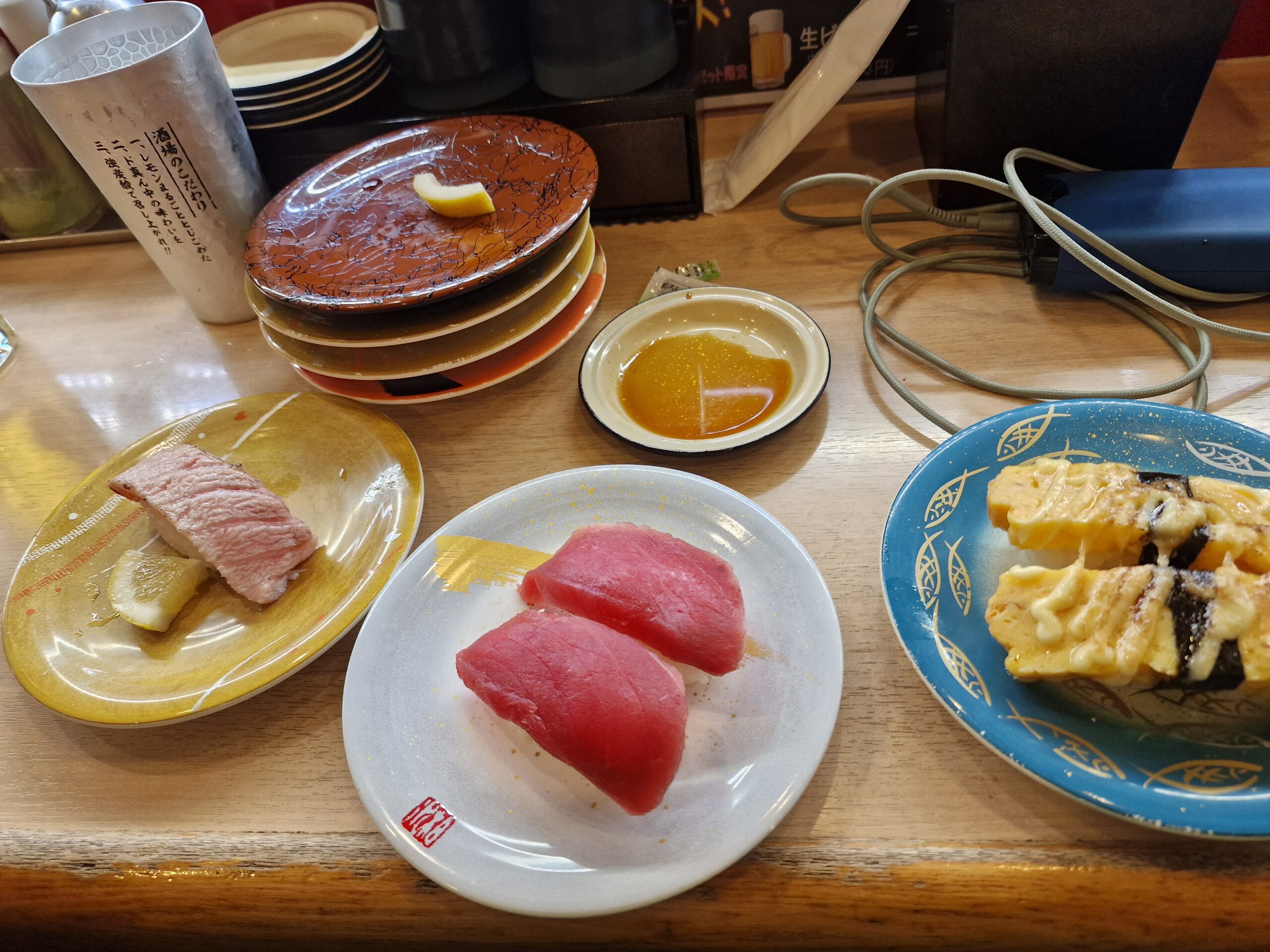
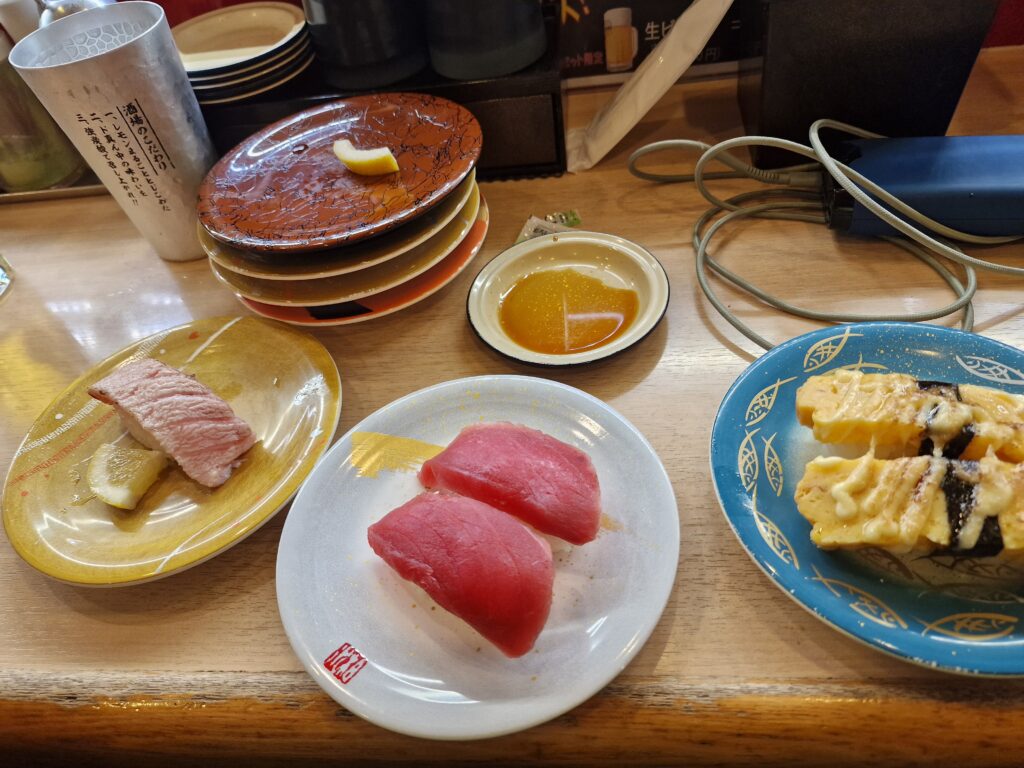
- A nigiri (握り) is a piece of something, usually fish, on top of rice. It is the kind of sushi you see in the sushi-emoji 🍣.
- The gunkan (軍艦, ‘battleship’) is a cup of rice and dried seaweed filled with seafood (fish roe, tuna salad,…)
- Norimaki are rolled rice, seafood, veggies,… in seaweed sheets. (Rolls without the seaweed are called ‘maki‘)
- The slices of fish without rice are called sashimi (刺身).
- Temaki are cones of nori that are filled with rice, seafood and veggies.
Some adjacent dishes include chirashizushi (mixed ingredients in a bowl rather than as a premade bite), temarizushi (little balls of rice with fish), oshizushi (pressed/flattened in a mold) and inarizushi (deepfried in a bag of tofu, with sweet and savory varieties).
It is good to note that maki in Japan are usually rather simple, in contrast to the trendy rolls in the West. A notable exception to this, are the extravagant creations at chain restaurants like kaitenzushi. They try to stay competitive by changing their menu often, by experimenting with bolder rolls (e.g. California style) and by collaborating with famous chefs. Other items on the menu of these chains include tempura shrimp, dessert options and even yōshoku (Western-style) dishes like Hamburg steak.
📖 Lexicon: Sushi Ingredients 🇯🇵
| 穴子 | Anago | Saltwater eel |
| 甘海老 | Amaebi | Raw sweet shrimp |
| 海老 | Ebi | Cooked shrimp |
| ガリ | Gari | Pickled ginger (palate cleanser) |
| 帆立 | Hotate | Scallop (often served raw) |
| 烏賊 | Ika | Squid (usually served raw) |
| イクラ | Ikura | Salmon roe (fish eggs) |
| 蟹 | Kani | Crab |
| 蟹蒲 | Kanikama | Imitation crab, made from surimi (すり身, fish paste), not real crab |
| 鮪 | Maguro | Tuna |
| 海苔 | Nori | Seaweed |
| ネギトロ | Negitoro | Chopped fatty tuna |
| 醤油 | Shoyu | Soy sauce |
| 蛸 | Tako | Octopus (usually boiled) |
| 卵 (casual) 玉子 (culinary) | Tamago | Egg. Usually in reference to tamagoyaki |
| 玉子焼き | Tamagoyaki | Sweet and savory layered rolled omelette, used in Tamago Nigiri. |
| 天ぷら | Tempura | seafood or vegetables, coated in a thin batter and fried. |
| 飛び子 | Tobiko | Flying fish roe (fish eggs) |
| トロ | Toro | Rich, fatty belly meat of tuna |
| 鰻 | Unagi | Freshwater eel |
| 雲丹 | Uni | Sea urchin |
| 山葵 | Wasabi | Unless freshly prepared, usually: a spicy paste of horseradish, rather than actual wasabi root. |
🍣 Where to find your sushi fix? 🥢
Types of Sushi-ya (sushi restaurants)
Roughly, there are four to five kinds of experiences to try (or not try) when travelling in Japan. They each have their selling point, their accompanying price points and experiences. These are:
- Machi no sushi-ya (町の寿司屋) are local, family-run, counter restaurants. These restaurants offer an authenticity that can not compete with the bigger chains and do not set you back nearly as much as a fine-dining experience. They are a bit more pricey than the conveyor belt restaurants. Just like any other eatery, they can be hit or miss. We advise to check a local dining app. They will help you separate the wheat from the chaff.
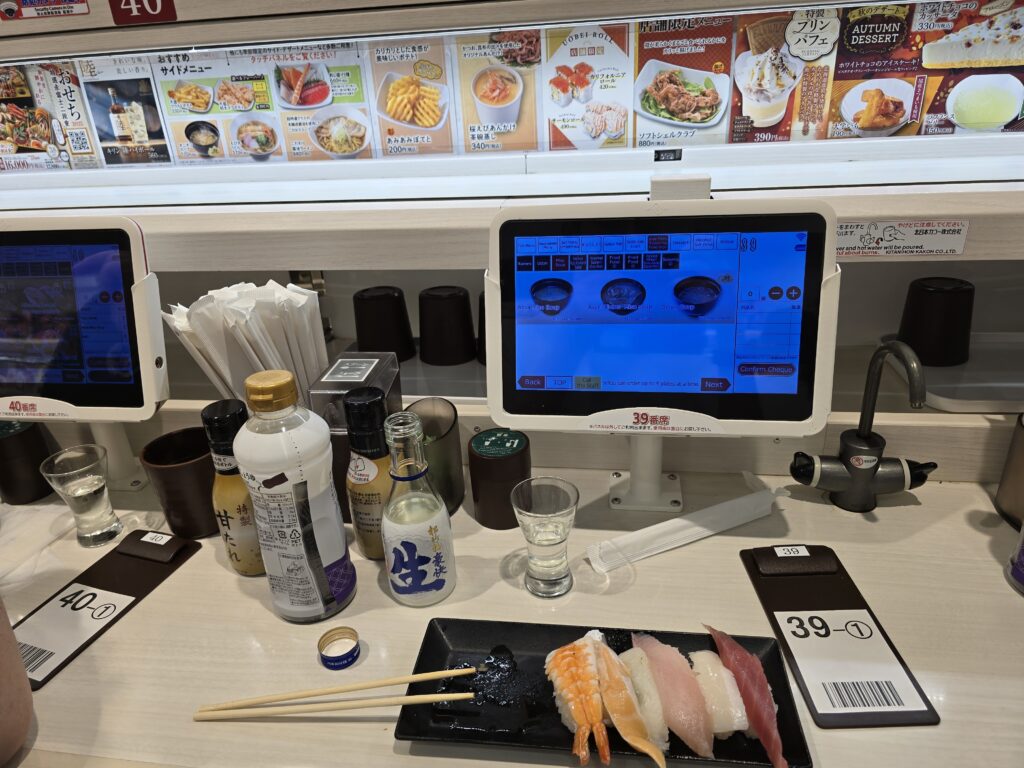
- The big chains with conveyor belt sushi (kaitenzushi, 回転寿司). These are the classic experience most tourists have. When you eat at a sushi chain restaurant, chances are really high that they offer this kind of experience. Mileage may vary per chain and even per location, but for most of us this will still be way better than the sushi we eat at home (even compared to specialised restaurants). You will be surprised by the affordability a lot of these restaurants offer!
- An in-between option are more local conveyor belt restaurants, that are not part of a big chain. Ideal for when you do not want to interact as much. (We all have those days where our social battery is just that empty. And this option is ideal for those who do not feel comfortable speaking Japanese or Japenglish with the staff!)
- Omakase (お任せ) style restaurants are found at the top-end of the price ladder. This sushi is chefmade, often in front of you and the courses are set by the restaurant. They are to take you on a culinary journey from dish to dish. This is partly an experience-based way of eating sushi, where the sushi may or may not be at the center of the show.
- Last on our list is the sushi you can find in konbini and supermarkets. Usually this sushi is premade, but it is also considerably cheaper. Ideal on the go, or late at night when restaurants are closed and you want to get a bite to eat at your hotel room. (Tip: When you visit a supermarket near closing time, they offer up fresh dishes at a discount!)
🍣 From personal experience 🥢
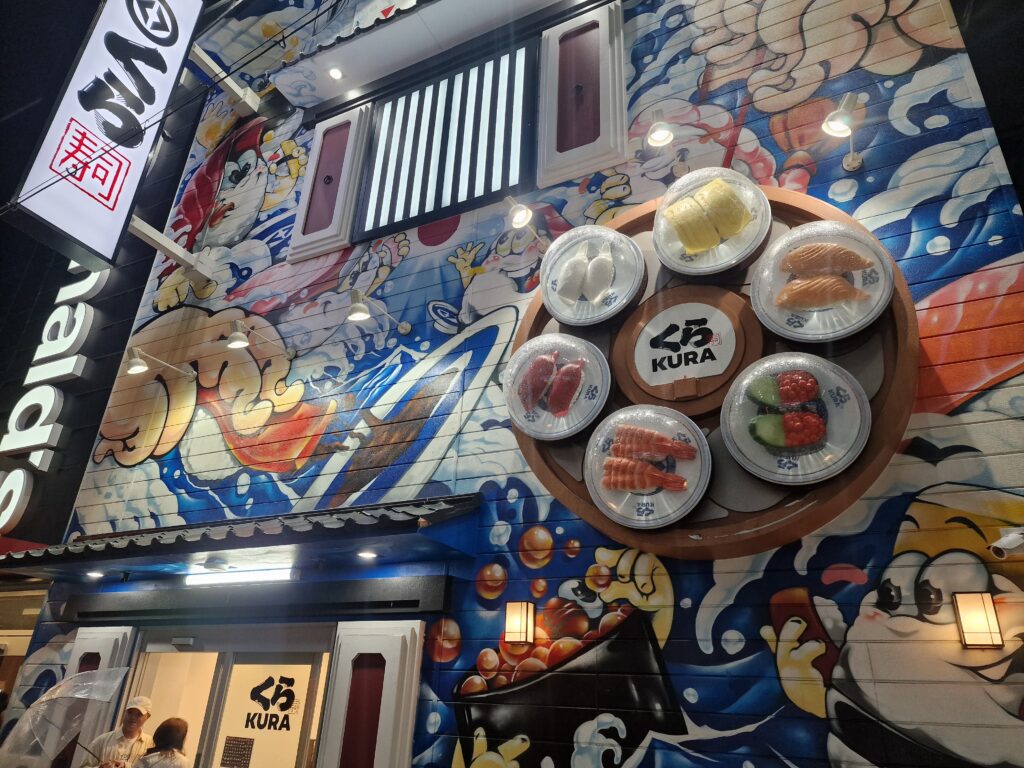
During our trip in Fall 2024, we went for sushi twice. Our first foray was at a Shibuya branch of Uobei. The second time we wanted to try a big chain, Kura. But having tried the line at a few different branches, we ended up in a more local restaurant near Kanda station. It was an unexpected but wonderful experience. The realness and grittiness of the place offered us something a chain would never have…
Apps to help you find your restaurant
To help you find the restaurant that is right for you, these are some apps to help you out:
- Google Maps has great options in English, but the ratings are mainly those of other tourists. That is great when you want the most approachable of experiences, but they usually are not the most authentic.
- Tabélog is the local restaurant rating app. They also have an English version of the app.
- Other apps are Gurunavi (autotranslated into English), Hot Pepper (Japanese only), Tablecheck (less coverage), Hitosara (for higher-end dining), Happy Cow (vegan and vegetarian options),…
Be aware: Japanese rate restaurants differently. On Google Maps one-star and five-star rating are used pretty liberally. Japanese people mainly give two to four star ratings (ranging from bad over good to very good) One and five stars are really, really rare.
About the dish
🍣 Local etiquette 🥢
General food etiquette
There are a few general practices to take into account:
- If oshibori (wet towels) are provided, please use them to clean your hands before the meal.
- At the start of your meal a simple “itadakimasu” to show thanks and to wish each other a good meal. (Lit.: “I gracefully receive”). At the end of the meal, you can thank both the chef and the meal itself with “gochisōsama deshita” (Lit.: “It was a feast.”)
- Large bowls are usually not meant to be picked up, but you can bring food from that bowl to your own plate. When eating from small bowls, however, the polite way is to bring the bowl close to you.
- When using chopsticks, there are a few practices that are considered taboo or ‘kiraibashi’ (Lit. ‘Hated chopsticks’). These include: sticking chopsticks straight up in your rice, passing food directly between chopsticks, spearing food onto the chopsticks, hovering over dishes with your chopsticks when deciding what to pick, licking the chopsticks, using the chopsticks as a lever to pull dishes closer to you,…
Etiquette when eating sushi
Besides those general etiquette pointers, we also have a few more pointed tips, that may or may not apply to your situation:
- Sushi can be eaten with your hands, although the dominant way can differ from style and setting. Some high-end omakase chefs even prefer guests use clean hands to protect the delicate texture of the rice. Sashimi on the other hand is an example of a dish that will always be picked up with chopsticks. But however it is being picked up, the piece is almost always meant to be eaten in one bite.
- It is totally okay to put some wasabi in your own soy sauce at a chain restaurant. When you are at a restaurant where the chef prepares the dish for you, however, the general consensus is to eat the dish as recommended by the chef. (i.e. The wasabi will be added by the chef where they deem it applicable.)
- Try to dip only the fish in the soy sauce. For more complex styles, like gunkan, you can drizzle the soy sauce directly over the piece, or you can use a bit of ginger as a brush.
- In kaitenzushi restaurants, there can be two kinds of belts. One delivers ordered items to your place. You can only take what you ordered for yourself from these belts. Sometimes there is also a continous belt, where other dishes and condiments travel on. You can take plates from this belt as you please.
- Also at kaitenzushi, your plates are marked (e.g. by colour) to indicate a price point. At the end of the session, all plates are counted to determine the total cost of your meal. Sometimes, there are also systems that automate this. Kura, for instance, is famous for its Bikkura Pon game where you can win prizes as you go, by feeding your plates into a counting system right at your table.
- Eating at an omakase restaurant (or any upscale or famous location) usually also means that a reservation will be necessary. Be aware: at most places, if you do not show up at the agreed upon time, your reservation is cancelled and a cancellation fee might be applied. (Usually there is a 15 minute grace period.) It is smart to check these things before you make your reservation.
🍣 Is there a prefered eating order? 🥢
The short answer is “Yes”, there is a prefered way to eat your sushi. The longer answer? “No, there really is not.” While some chefs want to tell a story during that fancy omakase dinner, the choice really is yours! But for those who do want it, here is some – optional – guidance that often holds when ‘sushi maxing’.
The general kaiseki and omakase arcs move you from light and delicate flavours to the more richer, fatter and bolder ones. The idea here being that you won’t taste the lighter ones as well when you would reverse this order. For sushi, that generally means that you would order white fish before silver skinned fish before richer items and end the whole meal with tamago or light rolls.
- Light, mild fish
- Silver skinned, or vinegred fish
- (Lean) red fish
- Medium-fatty and fatty fish
- Shellfish and chewy textures
- Strong flavours and bold ideas
- Maki (reset if the palette)
- Dessert
That being said, it is important to reiterate that this is a chef-created narrative and not an obligation thrusted on the individual order you place when enjoying your sushi the way you want to enjoy them. Even chefs do not always follow this way of eating as they see this as a narrative that is too linear, without much room for culinary surprises.
📖 Lexicon: Sushi Styles 🇯🇵
- Kaiseki (懐石): a traditional, deliberate sequenced multi-course meal. It is usually seasonal, has 6-15 small plates and is artistry in nature. (The idea is heavily connected to the Japanese tea ceremony in Zen buddhism.)
- Omakase (お任せ): Literally ‘I entrust you with it.’ A multi-course formal dining experience where the chef decides the courses.
- Kaitenzushi: Conveyorbelt sushi
- Sushi-ya (寿司屋): Sushi shop, sushi restaurant
Remember: Sushi does not originate from the prim and proper stems of fine dining! The choice really is yours!

The history of sushi
🍣 A short history of sushi 🥢
In past centuries, “sushi” referred to pickled fish preserved in vinegar. Nowadays it can be just about any combination of rice with sushi vinegar and (raw) (shell)fish and/or vegetables. The OG dish, a traditional form of fermented sushi, is now known as Narezushi (熟れ寿司, “matured sushi”). The history of sushi can be divided into four or five rough periods.
Origins
Sushi probably has its origin on the Indochinese Peninsula and it was first documented by the Han Chinese around the second century CE as sa (鮓). This character specifically referred to narezushi. From there it travelled to the Japanese archipelago.
Narezushi was prepared by preserving fish in salted rice and letting it ferment. That is why the dish is called ‘narezushi’ (matured sushi): because the fish is ‘honnare’ (fully fermented). After the fermentation process had run its course, only the fish would be eaten. (The fermentation would turn the rice acidic.)
If you want to know what narezushi tasted like, it is still being made in Shiga prefecture, under the name of funazushi. It is made mainly with local fish, like nigorobuna carp caught in Lake Biwa.(It is considered the oldest Japanese form of the dish still in existence.)
Modern forms
During the Muromachi period (1336-1573) people started to eat the dish namanare / namanari (lit. half-fermented). Rather than waiting for the fermentation process to complete, they would eat the fish slightly earlier. It was at this point people started to eat the slightly tart rice too, rather than letting it spoil.
Only in the Edo period, the fermentation process was abandoned and replaced with the addition of rice vinegar to the rice. This would emulate the flavour pattern. It resulted in a new form of sushi called hayazushi (lit. fast sushi). A chef named Hanaya Yohei is credited with the invention of the nigiri. This form would become popular among the working class, that would have it as an easy streetfood. (Fun fact: There is a chain of sushi-ya named after this chef.)
Like many other Japan staples, sushi started to spread globaly after the Second World War. Today, sushi is a dish that is often enjoyed by Japanese people as a treat on special occasions. It is a very popular food, both in Japan and abroad. When you get the chance to visit the country, try out their sushi-ya. We promise you: it will be an experience!