The world’s largest museum of applied arts, decorative arts and design.
| 🎫 Tickets | £ 0,- |
| 🕐 Opening hours | Daily from 10:00 to 17:45 Late opening on Fridays until 22:00 Closed on certain bank holidays |
| ⏱️ Time needed | 2-3 hours |
V&A South Kensington
Cromwell Road
London SW7 2RL
On this page…
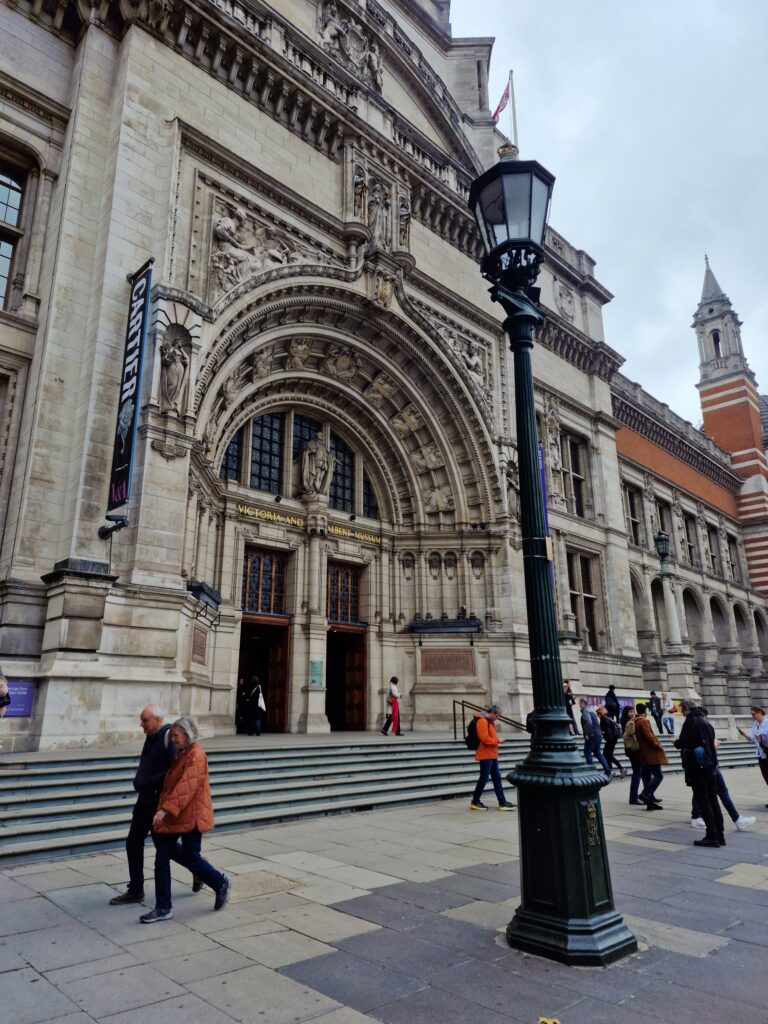
Out of all museums at Exhibition Road, I think the V&A is the one we have been to the most. And yet: on our last trip we stumbled upon a whole new wing we hadn’t discovered before. The museum has a collection spanning centuries of design, crafts, art. And because of that, every visit of the museum so far has been vastly different.
As a fan of ‘museums of museums’, I very much enjoy the fact that you can still enjoy a cup of coffee or even a full meal at the first ever museum café. The Refreshment Room dates all the way back to first director, Henry Cole. His philosophy was very much that the museum should be a schoolroom for everyone, and that comfortable visitors would visit the museum for longer periods at a time.
Similar sights
History of the V&A
The history of the Victoria & Albert Museum dates back to the 1851 ‘Great Exhibition of the Works of Industry of All Nations’ in Hyde Park. It was organised by Prince Albert, who used proceeds to buy what some called ‘Albertopolis’, a stretch of land at the southern side of the park. The museum itself was established the year after, in 1852. Its original name was the ‘Museum of Manufactures’ and the first director was Henry Cole. In these early days the emphasis was very much on practical use, as opposed to the ‘high art’ of the National Gallery and the ‘scholarship’ at the British Museum.
George Wallis, first Keeper of Fine Art Collection, promoted a wide art education. This led to the School of Design (the current Royal College of Art) transferring to the museum. The museum also came into more scientific collection pieces, for which improvised galleries on the west of Exhibition Road were used. In 1893 this would grow into the Science Museum.
The museum has grown over the years, and as of April 2026 is working from six different locations.

The V&A during the Blitz
During the Second World War, even at the height of the Blitz campaings over London, the museum tried to remain open as much as possible. The only exception to this was the period of the initial evacuation at the beginning of the attacks.
While Kensington was relatively safe, compared to East London and its Docklands, on 19 April 1941 bombs did explode on Fulham Road and Exhibition Road. It severely damaged the West side of the museum. Quite a bit of damage is visible to this day.
Parts of the collection (based on a A to D categorisation) were moved into safety together with those from the British Museum, at locations as Brompton Road and Aldwych stations, country houses such as Montacute House, to the Bodleian Library in Oxford, and other secret locations like a Wiltshire quarry. Immovable but valuable pieces – like the Raphael Cartoons – were protected on site, for example with sand bags. Empty sections of the V&A were used as temporary school for children evacuated from Gibraltar, the Board of Education was lodged in the Library offices, and the South Court was used as a canteen for the RAF.
V&A Permanent Collection
Locations
The public collection of the V&A is spread over multiple locations, four of which are in London:
Highlights (at South Kensington)
Just like with any extensive collection, it is only with great difficulty that you can determine what are the absolute top collection pieces. Luckily museums do it for us… According to the V&A itself, these are the South Kensington highlights:
- Cybele (Rodin, 1904-1905)
- Evening coat (Schiaparelli, Cocteau, 1937)
- Betel nut container (1780)
- Robe de chambre (1690-1720)
- Samson Slaying a Philistine (Giambologna, 1560-62)
- Sanchi Tope (1870-74)
- Gyeol_Flow bench (FABRIKR, 2016)
- Mazarin Chest (approx. 1640)
- Ardabil Carpet (1539-1540)
- Tippoo’s Tiger (approx. 1793)
With 145 galleries to choose from, you can immerse yourself in fashion, sculpture, photography, furniture, and ceramics spanning 5,000 years. Major, free-to-visit galleries include the British Galleries, Medieval & Renaissance, Islamic Middle East, and the Photography Centre.
One of those hidden gems we only recently discovered is the Kusuma Gallery. It is filled with photography and books on that very topic. The gallery is a quiet room in an otherwise pretty busy museum. Just like the Refreshment Room, the photography collection can also be traced back to Henry Cole. As an amateur photographer himself, he gave the impulse to the Victoria & Albert Museum to be one of the first to collect photographs as art.