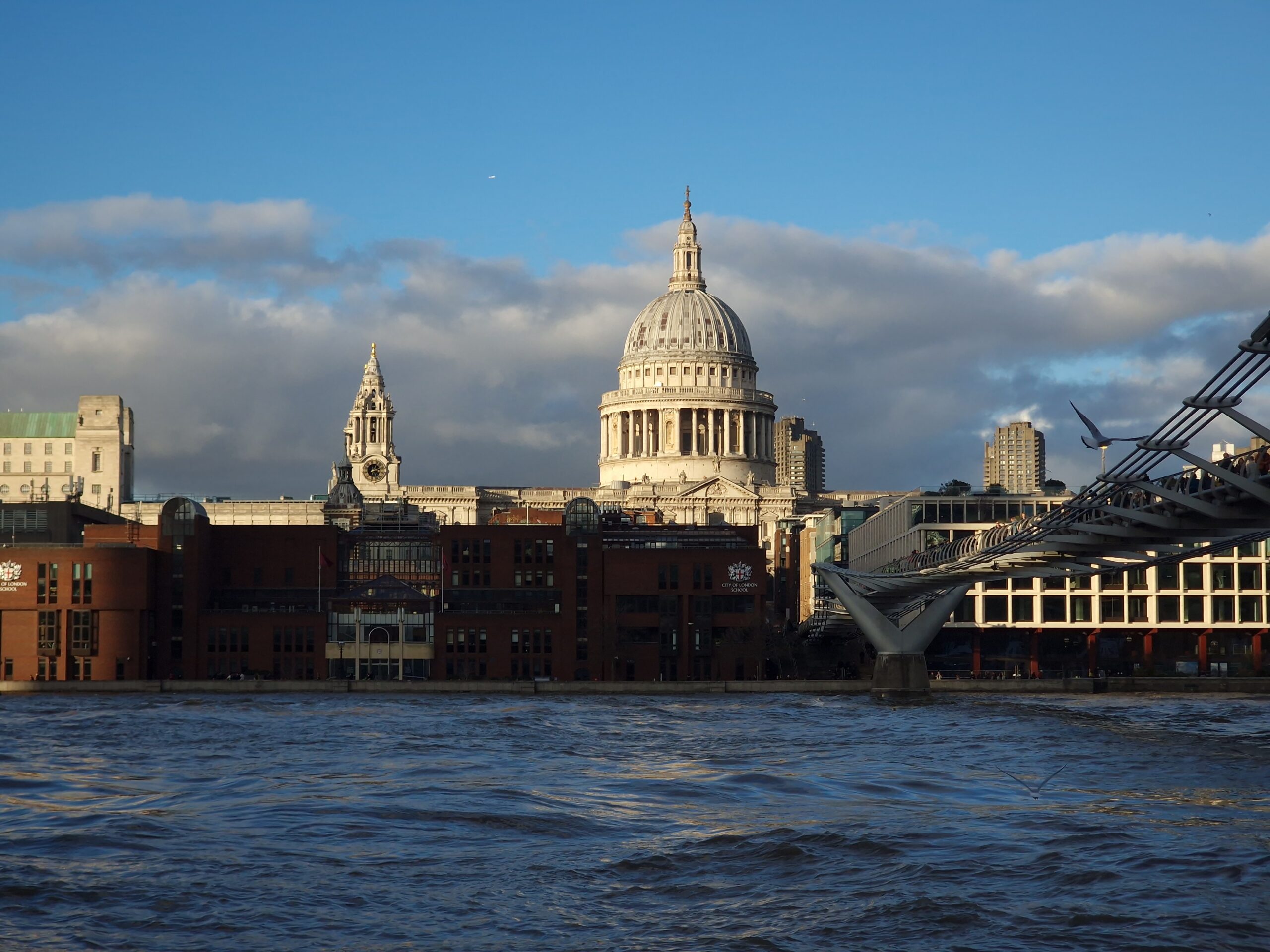
Saint Paul’s Cathedral is the cathedral church of the Diocese of London, within the Anglican Church. Sir Christopher Wren built the current building between 1675–1710, after the Great Fire of London (1666) destroyed Old Saint Paul’s.
Several views of the dome are considered so important, they are protected by law.
| 🎫 Tickets | Base ticket: £27 |
| 🕐 Opening hours | Monday to Saturday, from 8:30 to 16:30 (On Wednesdays from 10:00) On Sundays the cathedral only allows for worshipping. |
| ⏱️ Time needed | 1-2 hours |
| 📚 What to visit? | Cathedral Floor, Crypt and Dome Galleries. Geometric Staircase and the Quire (only accessible during guided tours). Triforium tour: the Library, the Trophy Room and Great Model |
Saint Paul’s Cathedral
St Paul’s Churchyard
London, EC4M 8AD
Join an event! / Access the cathedral’s collection online.
There is a choral evensong on most days at 5pm (3pm on Sunday). Access is free and unticketed. It is best to always double-check the calendar as other services might replace the evensong.
Choral mattins take place every Sunday at 10am. These services too are free to access and unticketed.
On this page…
There aren’t many buildings that breathe London-ness like the cathedral of Saint Paul’s. Its dome is so iconic that it got its own fire brigade during the Blitz. No less than eight vistas of it are protected by law. It is the ultimate visit card of Sir Christopher Wren, the architect of the second half of the 17th century.
Similar sights
History
The current building is the fifth church on site. It was built by Sir Christopher Wren after the Great Fire of 1666. Large parts of the City burned down, including the previous cathedral.
Londinium’s early Christianity
Saint Paul’s hasn’t always been the focal point for London Christians. While it is not entirely certain, legends claim Saint Peter upon Cornhill to be the central place of worship in Roman times. The tradition links Saint Lucius with the Londinium community at that spot. Another possible location for the first cathedral would be Tower Hill, were archeologists discovered the remains of a Roman basilica from the fifth century.
A logical follow-up question could be: what stood at the location of the current Saint Paul’s in Roman times? It was argued in Elizabethan times to be that of a temple to Diana, goddess of hunting. The hypothesis, however, is no longer accepted. (Furthermore: Wren reported to have found no traces of it, when constructing his cathedral on the site.)
Old Saint Paul’s Cathedral
Before Saint Paul’s there was… Well, Old Saint Paul’s. That is what people refer to when talking about the pre-1666, Norman building that stood on site. It was the fourth generation church. It itself was a replacement of the third church, that burned down in 1087.
The Normans built Old Saint Paul’s during the shift from Romanesque to Gothic, which reflected in the pointed arches and larger windows on the upper parts and on the eastern end of the building. Further enlargement works were undertaken in the fourteenth century. It became the world’s second longest and third highest church during this period.
The iconoclasm of the English Reformation led to the destruction of ornamentation and of the many shrines within the church in the sixteenth century. From 1631 classical architect Inigo Jones worked on the building until the start of the Civil War in 1642. The cathedral became ruinous. And by the 1660s, funds were raised to restore the building fully. When the Great Fire hit in 1666, it might have still be possible to reconstruct the old cathedral. But a decision was made: A new church would be built from the ground up, in the Classical style, by Sir Christopher Wren.
Blitz: Saint Paul’s Survives

While Old Saint Paul’s vanished in the flames of the Great Fire of London, Wren’s building survived what is called ‘the Second Great Fire of London’. A particularly harsh air raid on the night of 29-30 December 1940 dropped incendiary bombs over an area larger than the destroyed parts of the city after the 1666 fire.
Saint Paul’s, too, was hit. One of the incendiaries broke through the lead dome of the cathedral. It threatened to fall into the wooden support beams, but luckily it fell outwards onto the Stone Gallery. There, a fire watch team dealt with it swiftly. The team was put there by order of Winston Churchill himself. He saw the survival of the icon as paramount to the morale of the nation.
Early in the morning of 30 December, the Daily Mail’s chief photographer, Herbert Mason was firewatching from the roof of the newspaper. He took an iconic picture of the dome, rising from the smoke, that became an instant propaganda hit. (Interesting fact is that it was used on both sides, by both the Brits and the Germans. They both used the picture differently ofcourse…)
Some important services that took place in Saint Paul’s
- 1 May 1707: Thanksgiving after the Acts of Union
- 9 January 1806: State funeral of Vice-Admiral Horatio Nelson
- 18 November 1852: State funeral of the Duke of Wellington
- 22 June 1897: Diamond Jubilee of Queen Victoria
- 6 July 1919: Thanksgiving after the Versailles Treaty
- 13 May and 19 August 1945: Thanksgiving for VE and VJ Day
- 30 January 1965: State funeral of Winston Churchill
- 3 June 2022: Platinum Jubilee of Queen Elizabeth II
What to see
Inside the cathedral
At Ground Level
Out of the inside features of the cathedral, the geometric staircase might very well be the most famous feature. It served as a backdrop for The Madness of King George (1994), Harry Potter and the Prisoner of Azkaban (2004) and Guy Ritchie’s Sherlock Holmes (2009).
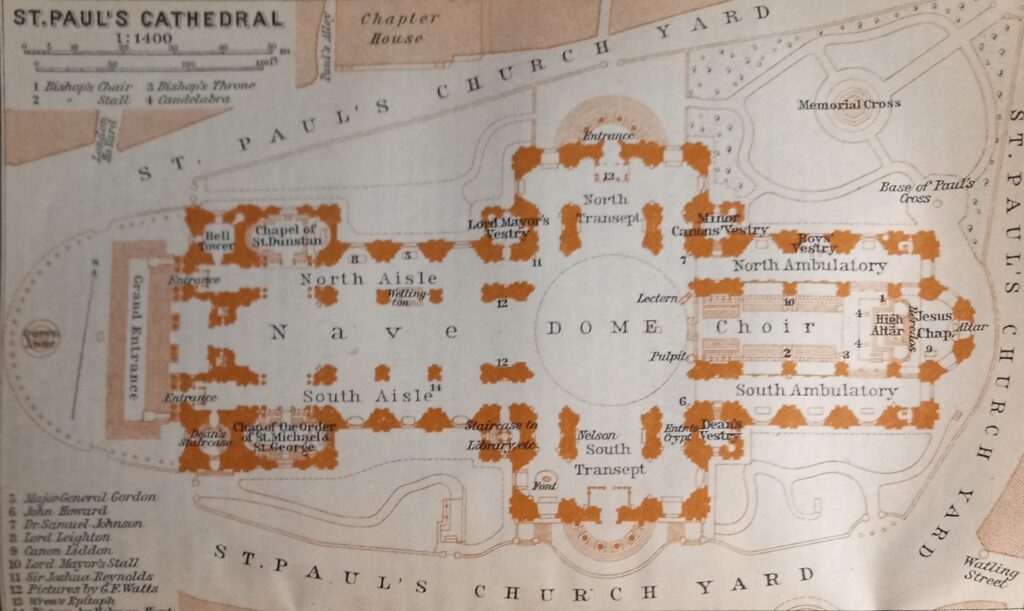
Also on the cathedral floor, is the Wellington Monument. It sits in an arch between the Nave and the North Aisle. It was completed only in 1912, sixty years after the death of the duke. Further down the aisle is the Quire. This is the oldest part of the current building. It is also where the cathedra, the throne of the bishop, sits. More to the east, still, sits the High Altar. The current altar dates from 1958. It is a replacement of a large, Victorian piece, damaged by a bomb strike in WWII. At the very back of the church, you will find a chapel dedicated to the 28,000 Americans in the UK who died during that war. The imagery on the wood carvings, the iron work as well as on the stained glass windows include Northern American plant and animal life.
Other important parts of the cathedral include the Library, the Trophy Room and the Great Model.
The Crypt
Below the cathedral floor sits a crypt that inters many statespeople, artists and scientists. Chief among them: the architect of the cathedral itself, Sir Christopher Wren. Other burial sites include that of Lord Nelson, Duke Wellington, Sir Henry Wellcome, and Alexander Fleming. It also features memorials to the Falkland War, to Florence Nightingale, to Sir Winston Churchill, the knights bachelor, and many more.
The Dome
Above it all sits the famous dome of Saint Paul’s. It includes the Whispering Gallery and the external Stone and Golden Galleries. The Whispering Gallery runs on the inside of the interior Dome, and as its name suggest: due to a quirk in the construction of the room, you can hear whispers all the way on the other side of it. The Stone Gallery is the lower outer gallery that encircles the outside of the bottom of the outer Dome. The Golden Gallery, finally, sits atop of the outer Dome.
Please be aware: These galleries are only accessible via staircase. They sit at 257 steps, 376 steps and 528 steps high, respectively.
From the outside
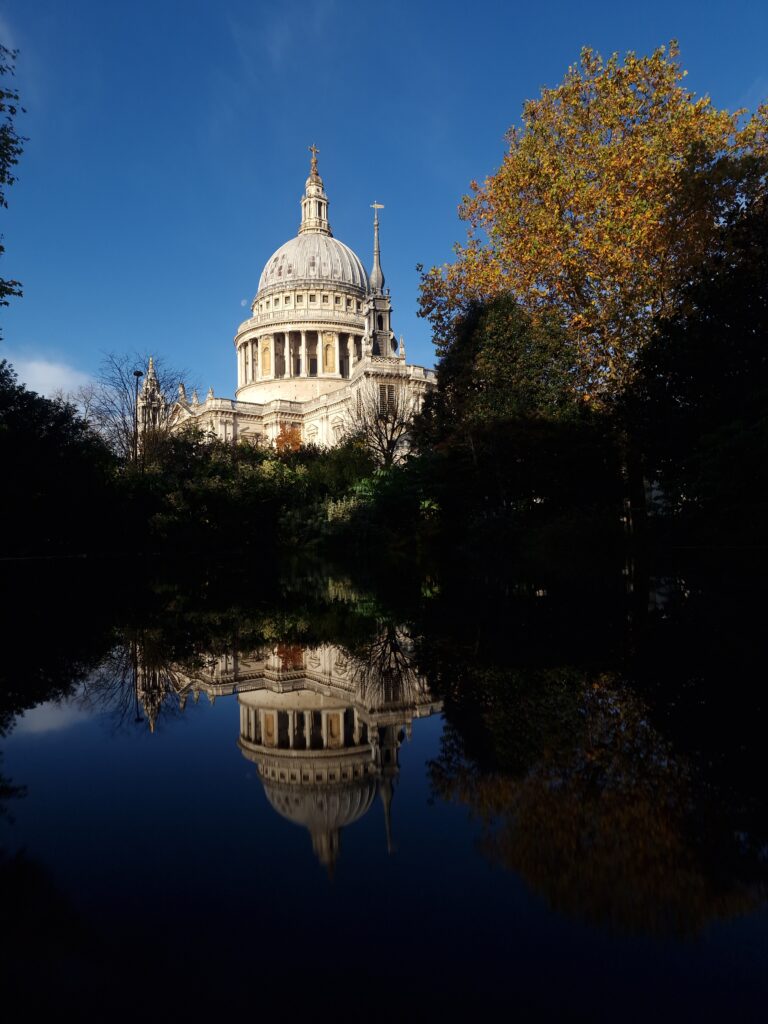
Just east of the cathedral, underneath the building at 25 Cannon, a popular reflection pool captures the dome of Saint Paul’s in the water.
It is not the only precious view of the cathedral you can find in the city. There are even eight protected vistas that include the dome!
The following places should always have an uninterrupted view on the dome of Saint Paul’s Cathedral:
Alexandra Palace, the summit of Parliament Hill, the viewing gazebo at Kenwood House, the summit of Primrose Hill, the viewing point at General Wolfe in Greenwich Park, Point Hill Park in Blackheath, Westminster Pier and King Henry VIII’s Mound in Richmond Park.
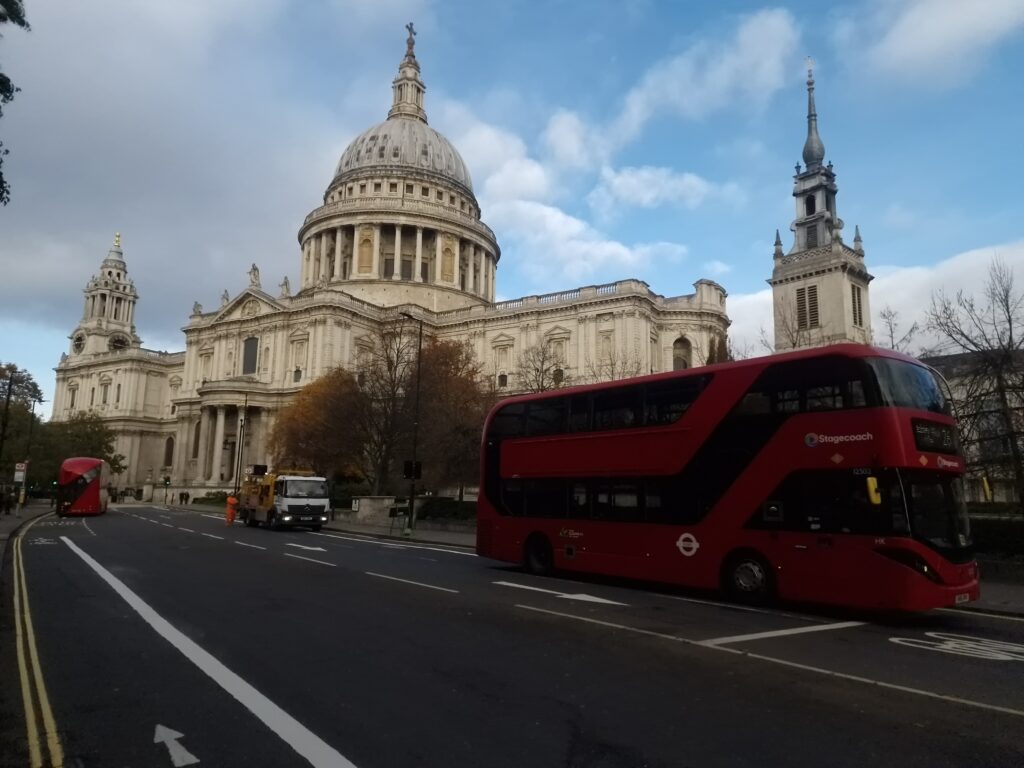
The most renowned feature of the cathedral has to be the iconic dome. Its summit sits at 111 meters above ground floor level (365 ft.). The height supposedly references the days of the year. (Sir Christopher Wren had an enormous interest in astronomy.) The dome itself draws heavily on Saint Peter’s Basilica in Rome, and churches like Les Invalides and Val-de-Grâce in Paris. However, Wren’s dome rises from two clearly defined stonework storeys.
Another major point of the outside design is the west front. The Baroque facade features two-tiered paired columns of Portland stone. It features a grand classical portico, two bell towers and a statue of Saint Paul.
Lector, si monumentum requiris circumspice.
“Reader, if you look for his monument: look around you!”
~ final words on the plaque next to Sir Christopher Wren’s grave.